
Most international students never read their waiver denial letter closely enough to see why it happened. By the time they find out, the university has already charged their student account for the full school plan, sometimes over $2,000 to $4,000 a year. One missed detail on a waiver form, and that bill lands anyway.
Universities don’t ask if you want their insurance. Most automatically enroll every full-time student, including international students, into the school-sponsored plan the moment you register. The only way out is a waiver, and the waiver only works if your outside plan matches the school’s checklist exactly.
The mistake: treating the waiver as a formality
Students often assume that having some health insurance is enough to waive out of the university plan. It isn’t. Schools set specific benefit minimums, and a plan that looks solid on paper can still get rejected if it’s missing one line item.
At the University of Utah, for example, an outside plan needs a U.S. billing address, a U.S. phone number, and a U.S. contact person before it even gets reviewed. At Ohio State, an exemption is only granted if the alternative plan is a government-sponsored plan the university has separately approved, with written confirmation that the government covers costs the insurance doesn’t. Neither of those requirements is obvious from a standard travel or home-country policy.
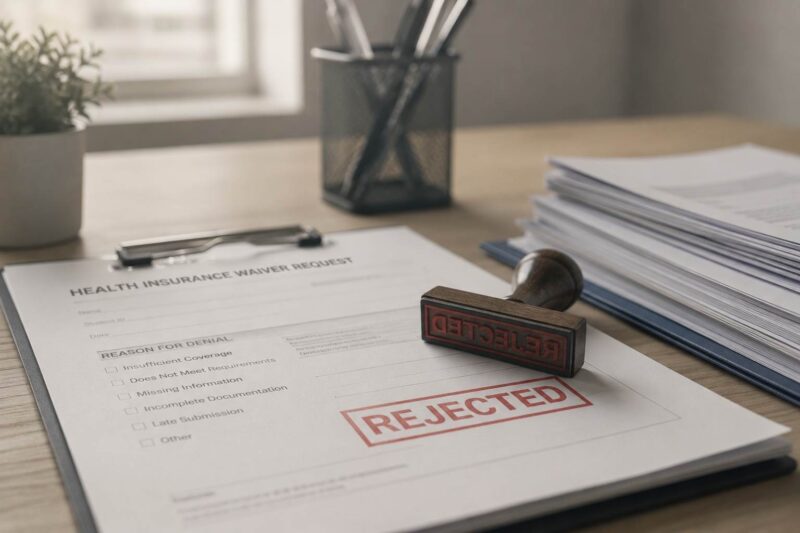
Miss one line and the waiver gets denied. When that happens, you’re back on the university plan by default, and the charge is retroactive.
Why the waiver gets rejected
A few patterns show up again and again.
- The plan is priced for short trips, not a school year. Travel insurance covers emergencies for a few weeks. It rarely covers routine visits, ongoing prescriptions, or a full semester of care, and it fails most university waiver checks outright.
- The insurer has no U.S. claims office. Many schools require domestic claims processing so the university can verify coverage. A policy underwritten entirely outside the U.S. often gets flagged for this reason alone, even when the coverage amount is high.
- The deductible or coverage cap is too low. Universities set a floor, not a suggestion. A plan with a $1,000 deductible might be fine for one school and rejected outright by another with a $500 cap.
- The visa category has its own rules. J-1 and J-2 visa holders face federally mandated minimums that F-1 students don’t. A plan can meet a university’s general requirements and still fail for a J-visa holder because it’s short on medical evacuation or repatriation coverage.
- The submission is late. Waiver windows close fast, sometimes by a fixed date each academic year, with no extensions once the deadline passes.
What a compliant plan actually needs
Requirements vary by school, but the categories below cover what shows up on nearly every waiver checklist.
Supporting documents should also be easy for the university to verify, especially when they were originally issued outside the United States. If any records need to be translated, understanding the requirements for official document translations before submitting your waiver can help prevent unnecessary delays.
| Requirement | Why it matters |
| U.S.-based claims office | Lets the university verify and process your coverage |
| Minimum deductible cap | Prevents high out-of-pocket exposure per incident |
| Inpatient and outpatient coverage | Covers both hospital stays and routine visits |
| Mental health coverage | Increasingly required, often with a minimum visit count |
| Medical evacuation and repatriation | Mandatory for J-1/J-2, frequently required for F-1 too |
| Coverage dates matching enrollment | No gaps between semesters or terms |
For J-1 and J-2 visa holders specifically, federal rules set hard numbers: at least $100,000 in medical benefits per accident or illness, $50,000 for medical evacuation, $25,000 for repatriation of remains, and a deductible no higher than $500.
Falling short on any single figure sinks the waiver, regardless of how strong the rest of the plan is.
The real cost of getting it wrong

The financial hit isn’t limited to the insurance premium itself. A rejected or missed waiver typically triggers:
- Automatic enrollment in the school plan, often billed by term, with a full academic year running well over $3,000
- A late fee or academic hold if the charge goes unpaid, which can block registration until it’s resolved
- Duplicate coverage, since you’re still paying for the outside plan you originally bought
- Lost time, since waiver processing can take weeks, and reapplying mid-semester isn’t always possible
At schools with dependent coverage, the stakes multiply. Columbia’s plan, for instance, prices a student and spouse together at just under $14,700 for the year when both are on the default plan. That’s the kind of bill a correctly filed waiver avoids entirely.
How to avoid the mistake
A few habits separate students who get their waiver approved from those who don’t.
- Pull the university’s exact requirements first, not general advice. Every school publishes its own minimums, usually through the student health portal.
- Check the visa-specific rules. F-1 and J-1 requirements are not interchangeable, and applying F-1 logic to a J-1 plan is a common reason for rejection.
- Confirm the claims office is U.S.-based before you buy the plan, not after you submit the waiver.
- Submit early. Aim for several weeks before the deadline, since processing time is rarely instant and errors need time to fix.
- Keep every document ready in English. If your original policy documents, medical records, or prescription history are in another language, get them translated before submission. Universities and insurers won’t accept documentation they can’t verify, and a service offering medical translation services can turn foreign-language records into something a waiver reviewer will actually accept.
- Save proof of submission. A confirmation email or portal timestamp is what you’ll need if the university claims it never received your form.

Conclusion
The waiver process looks like paperwork, but it functions like an eligibility test. Universities aren’t checking whether you have insurance, they’re checking whether your insurance matches a specific list of numbers and terms. Students who lose money on this usually aren’t uninsured.
They bought a plan that was close, but not close enough, and found out only after the school plan had already been charged to their account. Reading the requirements before buying, not after, is what keeps that charge off your bill.